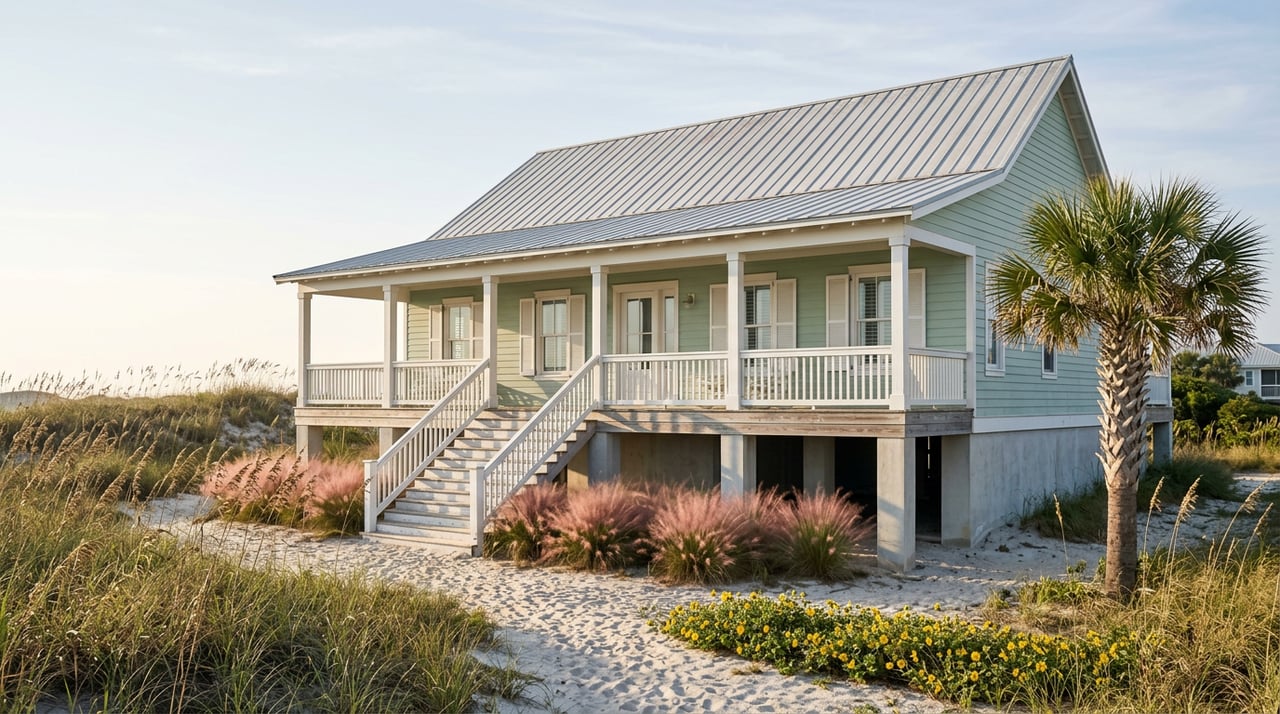
Walk south on Hotz Avenue past the Red Bar this summer and you will run into a building that was not there a year ago. It sits low and square at 44 Hotz Avenue, just south of Chiringo, with a roofline that pitches up at an odd, deliberate angle. Most people passing through on their way to the sand will not think twice about it. They should. That roof is a copy of a wooden watchtower the Coast Guard built in Grayton Beach during World War II to watch for German ships offshore, and the building underneath it opened on June 15, 2026 as the county's newest public beach access. The shape is not decoration. It is the whole point of the place.
Grayton Beach has spent decades being the town that stayed small while everything around it on 30A got taller, denser, and more polished. The new Community Center and Regional Beach Access is the first piece of public infrastructure the village has gotten in years, and it was built to remind people why that smallness was never an accident.
What actually opened
The facility is compact by design, about 1,600 square feet, with restrooms, rinse showers, a boardwalk connection straight to the beach, and a 360-degree observation deck that looks out over the dunes and the Gulf. It plugs directly into the Walton County Beach Park and Ride system, so anyone who parks at the Grayton Beach Park and Ride on County Highway 283 can ride the free Beach Tram in rather than hunting for street parking on DeFuniak Street or along 30A. Florida State Parks and the county expanded tram service to Grayton Beach State Park and Topsail Hill Preserve State Park at the same time, which means the access point at Hotz Avenue is now tied into a bigger, free shuttle network rather than standing alone.
County officials designated it the eleventh Regional Beach Access in Walton County. That number matters more than it sounds like it should. Eleven access points across an entire county coastline is not many, and it tells you something about how tightly the public entry points to this shoreline have been rationed over the years, on purpose, to keep the beach from being overrun with parking lots and boardwalks every quarter mile.
The roof is not just architecture
Inside, the center houses a small local information station about the founding and early history of Grayton Beach. The roofline gets explained there too. During World War II, a Coast Guard unit was stationed in Grayton Beach specifically to keep watch for German ships and submarines moving along the Gulf coast, and the unit built a wooden pyramid-shaped tower to do it from. That structure is long gone, but the new center's roof was shaped to echo it directly.
It is an unusual choice for a beach bathroom and boardwalk facility, and that is exactly why it works. Most public beach access buildings on 30A are functional and forgettable, a place to rinse sand off your feet and refill a water bottle. This one was built to make you ask a question, and the answer connects a summer afternoon in 2026 to a stretch of history most visitors never hear about: that this quiet stretch of coastline was once considered important enough to guard.
The name on the building
The access is named for Bets "Beachmama" Haynes, a longtime Grayton Beach resident who died in 2005. Haynes led the grassroots campaign that convinced the State of Florida to buy nearly 900 acres of coastal land here in 1985, land that became the core of what is now Grayton Beach State Park. Without that purchase, the dunes, the pine flatwoods, and the shoreline between Grayton Beach and Gulf Trace could have gone the way of denser development seen elsewhere on the Gulf coast in the decades since.
That 1985 acquisition is the reason Grayton Beach today still has a mile of protected sugar-white beach, a 100-acre coastal dune lake in Western Lake, and miles of hiking and biking trails woven through scrub oak and magnolia rather than condo towers. Haynes and her family, well known around town as the "Grayton Girls," pushed for that outcome at a time when it would have been much easier to let the land go to the highest bidder. Putting her name on the county's newest beach access, in the middle of the village she fought to protect, is the kind of civic gesture that only means something if you already know the backstory. Now, thanks to the exhibit inside, more people will.
A building that argues with itself, on purpose
There is a small irony built into this project that is worth sitting with. The county spent years planning and constructing new public infrastructure, the kind of development that in most beach towns eventually invites more infrastructure, in order to honor a woman who spent her life fighting to keep this particular stretch of coast undeveloped. The center does not resolve that tension. It just makes it visible, right there in the observation deck and the boardwalk and the local history plaques, for anyone willing to read them.
That is a more honest way to mark growth than pretending it is not happening. Grayton Beach is still changing, slowly, deliberately, in ways that keep showing up in small doses: a new taqueria in a storefront that used to be a noodle bar, a bakery collaboration between a local chef and a well-known coffee roaster, now a beach access with a Coast Guard-shaped roof. None of it moves fast. That has always been the town's whole personality.
What a day near Hotz Avenue looks like now
For anyone who already lives around Grayton Beach, the practical upside is straightforward. A few things worth knowing if you have not been down to Hotz Avenue lately:
- Free parking is available on DeFuniak Street and along 30A, with paid parking at the Grayton Beach Park and Ride on County Highway 283.
- The Beach Tram connects the Park and Ride directly to the new access point at no cost.
- The center sits close enough to walk to Chiringo, the Red Bar, and AJ's Grayton Beach without needing to move your car at all.
- Dogs are welcome on the trails inside Grayton Beach State Park and in the campground, though not on the beach itself within the park boundary.
That last point matters for anyone who treats the state park trails as part of a regular walking loop. The new access at Hotz Avenue is not inside the state park, so it operates under the county's public beach rules rather than the park's, but the trail and campground pet policy is worth knowing if your route tends to wander between the two.
Put those pieces together and the new center becomes less of a single destination and more of a hinge point in a loop that a lot of Grayton residents already walk without thinking about it: coffee or breakfast at Black Bear Bread Co., a stop at one of the galleries in the Shops of Uptown Grayton like Saczynski Gallery or The Studio Gallery, a walk down to the water past the new observation deck, then dinner at Grayton Seafood or a beer at the Grayton Beer Brewpub before the Red Bar fills up for the evening. The access point does not replace any of that. It just gives the walk to the water a little more to look at, and a little more to explain to the next person visiting who asks what that odd roof is all about.
Grayton Beach has always been a town people describe more by feeling than by fact. The new building on Hotz Avenue is a rare case of the town explaining itself in writing, right there on a plaque, for anyone who stops long enough to read it.
If you are curious what else is shifting in the neighborhoods along 30A, or you are thinking through what a property near a spot like this could mean for your own plans, Beach Escapes Coastal Living is always glad to talk through it. Schedule a Consultation whenever you are ready.